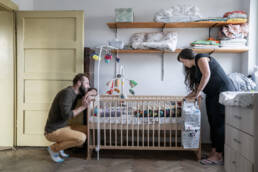
Ioana and Johnny
by Ioana Moldovan
In April 2004, when Ioana was finishing her 12th grade and was passionate about volunteering, she met Johnny during a youth cultural exchange, part of the European Commission’s Youth programme. They hit it off. At the end of the seven-day project, Ioana shook his hand in farewell and said: “I’m glad I met you, you’re a fantastic guy and I would have liked to get to know you better, to have a relationship, but there are 3000 kilometres between us.” Johnny was coming from Bergen, Norway.

I don’t see any reason for you to come to Romania and no chance of me getting to Norway. So good-bye!
Johnny laughs now at the reliving of that moment and remembers how he told her that it didn’t have to be “good-bye”, that they could write each other letters.
So they did. Johnny taught her in writing how to set up her messenger account, and Ioana would go to an internet café to chat with him. Back in those days, people were crazy about computer games, so she rarely found a free spot at a decent hour. On messenger, they would also schedule their phone calls, when Ioana would go to the post office and expect his call, so they could hear each other’s voice.
They met a few more times. First, Ioana went to visit Johnny at his home in Norway, right after she passed her university admittance exam. With the help of Elena, Ioana’s sister, Johnny convinced her parents to let her travel to Bergen. Ioana’s father told his daughter at the airport:
”You know, Johnny wanted to pay for the plane ticket himself, but I didn’t agree on him paying for the whole thing, I paid for half of it, and you should know it’s the return trip”.
After that it was Johnny’s turn to spend Christmas with Ioana’s family in Romania. No sooner had he landed in the country than he was picked up from the airport and introduced to the extended family at a surprise party with cousins, nephews and uncles. On Christmas Eve, he experienced his first culture shock. In Ioana’s family, a religious family from the village of Rudeni, Arges county, they were still fasting. “I was sitting there on Christmas Eve, a time when back home we eat a lot” – he explains that the Lutherans celebrate Christmas Eve in particular – “and I had carrot and celery salad. I kept waiting for other dishes to come, but to no avail,” Johnny recalls with amusement. Also at Christmas, he ate bulz – a Romanian dish made of roasting polenta, cheese and fried eggs – for the first time. With his blue eyes and tall, slender frame, Johnny became a favourite with Ioana’s grandmother.
In the summer of 2005, just over a year after they met, Johnny was to move to Romania. Ioana was entering her sophomore year at the university in Bucharest, and Johnny decided to finish his higher education here too. He gives a simple reason for his moving:
I think I was more determined.
Ioana adds that one of the main reasons why the balance has always tipped towards Romania, both then and in subsequent reassessments, was her very strong connection to her family.
They married in 2011. “I’ve been proposing since 2008,” says Johnny, “but Ioana sometimes needs a little nudge.”
“Nudges, indeed, but also these things that are more specific to our culture,” she says, “these standards that we’re raised with: that before you get married you have to be on your own, have a job, have a house. I was young at the time and I didn’t realise that these things didn’t matter.”
Just like at Christmas time, Johnny understood and accepted it. The fact that he is tolerant and flexible, that he respects all these traditions, is one of the things that Ioana really loves about him.
They had their religious wedding ceremony in an Orthodox church, with the first priest who accepted that Johnny didn’t have to be baptised in Orthodoxy. He was of the idea that Lutheranism is also a Christian religion. Until they found this priest, many clergymen had made it a condition of changing religion. Johnny, coming from a non-practicing family, didn’t understand why he should do this when he had never been very religious.

They are now the parents of three beautiful red-haired children, each with both a Romanian and a Norwegian name. Ioana speaks to them in Romanian and Johnny in Norwegian. At first, as a couple, they spoke English, although Johnny was beginning to learn Romanian. With time and a few discussions about the varied meanings behind the words, they decided that one of them should speak his native tongue. Living in Romania, it seemed only natural to choose the language spoken here.
For the holidays, they made a rule: to spend them one year in Romania, one year in Norway. Depending on where they are, they follow local traditions. With minor adjustments.
“I kept telling Ioana’s father about the lamb chops we traditionally cook for Christmas,” says Johnny, “and he said: Eh, we don’t eat lamb at Christmas, but we do at Easter, so he’s making me lamb chops in the oven for Easter.”
Of Ioana’s family, he says they’ve always gone out of their way to make him feel comfortable. Just as Ioana says of his own. They feel lucky to have had so much support from their families.
“We haven’t had any of these problems of everyday life, what we eat, how we dress,” Ioana says, “we learned over time what things Johnny couldn’t adapt to here, in terms of food and other stuff, as he learned what I can’t adapt to there.” On Johnny’s list is pig’s trotters, because “there is no salty jelly, there is only sweet jelly. Period.”
Beyond food, there’s one thing Johnny has had a hard time adjusting to in Romania: the perception of the importance of the given word, especially in relation to time.
“I’ve had the shock that a thing isn’t settled until it’s reconfirmed on the same day,” Johnny says with a laugh.
He recounts several stories, including one in which he and a Danish colleague waited for the owner of an apartment they wanted to see, at the time agreed the day before, but the owner never showed up because they hadn’t called him back that same day.
Ioana says that an important thing in their relationship is that they managed to figure out what’s at stake and not get worked up over things that don’t affect them. And that they talk about everything, traditions, religion, concepts, all sorts of things.
“I think we weren’t necessarily geared to just finding that common ground, but also understanding that the other is different and accepting that difference,” she says.
For Ioana, the things that define Johnny are “a constant crush,” and she took them as such, including “his Norwegian stuff.” “As we’ve gotten further along in the relationship, and I think also with age, we have a lot more willingness to see these things, we probably even see them faster and we understand them because we’ve gotten to know our roots better.” She explains how there are things about Johnny that she figured out later in the relationship, only after meeting his family and living in Norway for a longer period of time.
We’ve focused on understanding that we’re different and that we just somehow have one more difference.
Curiosity and openness to what defines the other are among the things that have kept Ioana and Johnny close. To these, they now add finding the best path for their children, and that includes the decisions they have to make about the education system. “We want to raise happy, confident children,” says Johnny. “Who grow up to be adults who can feel good about themselves,” Ioana finishes his thought.
Next:
Corina and Sándor