
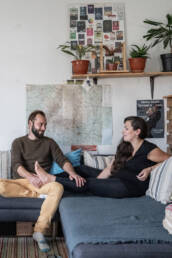
Corina and Sándor
by Ioana Moldovan
Seven years ago, Sándor left his home in Targu Mures, a town with a large Hungarian community, for a job at the Sibiu Philharmonic. He is a trumpet player. In addition to the classical repertoire, he also plays in a ska band, called Suburbia11.
In 2017, Corina was working on a prototype project, an app where you could find all the events in your city. She posted one of Sanyi’s – as Corina and his friends call him for short – band concerts in the app. Sándor somehow realised that she was the author of the mention and wrote to her on Facebook.

I saw her profile picture, thought she was cute and invited her to the concert.
“And I went,” she says, smiling, “and he didn’t notice me.”
Perceptions of the sequence of events that evening differ a bit for the two. Corina arrived at the concert with another friend. They were greeted by one of Sanyi’s friends, who, posing as the band’s manager, made them pay for tickets. The two only met at the end of the concert. “Corina’s friend was talking all night long, only her. We just kind of sat around and looked at each other.” They didn’t talk much. So they met again the next day.
Two weeks later, they moved in together.
“By mistake,” Corina says with a laugh.
A communication misunderstanding. “It really was, but it was a lucky one,” Sanyi adds. Sándor was living in a rented flat with a friend, and Corina kept visiting him as they spent more and more time together. At one point, Sanyi told her that he would like to move to a bigger place where she could come, stay longer, and have privacy. Corina understood that his wish was to move in together. “I basically wanted to move somewhere alone, without another friend, where she could visit,” says Sanyi.
“But he didn’t have the heart to tell me, so that was it,” Corina laughs.
They moved into the same apartment they still live in, on the first floor of a house with a small yard, where the two dogs they adopted from a shelter play. Next year, they hope to move into the house they are building together in Cisnadioara. They have chosen a place outside the city, closer to nature, because they both want, most of all, a quiet life. “The new house is closer to the forest,” says Corina, “especially for Boti, we both realised that it’s super important to not only take him out to the park for an hour a day, but to be somewhere where he can always play outside.”
Boti is short for Botond, their baby who is just eight weeks old. From the start, Corina wanted the baby to bear his father’s surname, Medve, a decision that Sanyi was happy about, especially as the idea had come from her. Corina doesn’t like it when she sees children bearing two surnames, both their mother’s and father’s. “In my head it’s that you couldn’t get along, that you couldn’t reach a compromise,” she says. “So it was my wish,” Corina adds, admitting she has no desire or pleasure in keeping her surname to pass on. “Plus it’s more interesting my name,” Sanyi teases her. Corina nods at him. “My name is Oltean and… it’s not very representative as we’re not even from the Olt region,” she laughs.
Regarding the name, they didn’t discuss whether it should be Romanian or Hungarian. It was somehow matter-of-course that it should go with the surname.
We wanted it to be a name that could be read the same in both Romanian and Hungarian, so as not to complicate his life because people couldn’t pronounce his name.
They searched hard. Now she has second thoughts. Every time someone asks what his name is and she answers Botond, the reaction is What? “Well, they can call him Boti,” Sándor reassures her. She explains that this happens because there aren’t many Hungarians in Sibiu, Botond being a common name among them. “If he goes to Cluj and says his name is Botond, people won’t be surprised,” she says. Sanyi sees the positive side again and jokes that by the time the child goes to university, he’ll learn to manage. They are making plans to send him to study in Cluj, Budapest or Oradea, “so there will be more like him.”
At home, between them, Corina and Sanyi speak Romanian. And sometimes small communication challenges arise.
“Out of all the Hungarians I’ve met, Sanyi speaks Romanian best and it’s hard to realise that it’s not his main language,” says Corina, “but even so, there are still some communication barriers.”
“I often can’t find my words, so I say it in other words or say it in another language, and we decipher it together,” Sándor explains. This often creates funny or memorable moments.
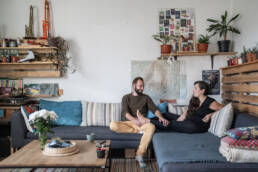
With Botond, they decided to speak one in Romanian, the other in Hungarian. Corina doesn’t speak Hungarian. Before she got pregnant, she had been taking Hungarian lessons on Skype, twice a week for about six months, with a friend and her Hungarian mother. Only conversation. Although she finds it a hard language, in the long run, and especially because Botond has come along, she aims to learn it. “Sanyi misses speaking Hungarian, as he has few to talk to in his language, and it would be nice for us, the family, to be able to talk to him.” Plus, she admits it’s frustrating when Sanyi talks to the child about her and she doesn’t understand, or when he talks to the dogs.
The pressure of language and cultural identity seems to have become greater with Botond’s birth. Until recently, they had no extended family discussions at all, except perhaps the remark made by Sanyi’s grandfather, more jokingly than seriously, that “she’s very pretty, this girl, but she’s not Hungarian“. Now Sándor’s mother is concerned about wether the child will learn Hungarian.
“If we’ve given him a Hungarian name, then he has to learn,” says Sanyi, “that’s what she keeps on telling me. How will he know who the national poet is? She’s worried that Hungarian culture won’t be passed on to the child.”
When it comes to school, for Sanyi “the most important thing is that it’s a good school.” Corina wants the same. She wouldn’t mind Botond studying in Hungarian, but given that the Hungarian community in Sibiu is quite small, she doubts they would find a good school.
Corina and Sanyi have been brought together by their passion for music. They want to pass this on to Botond. “I’ve been taking him to festivals for the whole pregnancy,” Corina says with a laugh. She can be seen, pregnant, swinging in a hammock, in the video promoting Suburbia11 at the Barefoot in the Grass festival in Targu Mures in July this year. “We love going to festivals,” says Sanyi. “Corina also helps me with the band, she’s in charge of our promotion, so we work a lot together.”
“It often happens at events that we’re there, I’m with the organiser’s team, he’s in the line-up,” adds Corina.
I love it when that happens, it’s cool, when we go to a festival, I have my thing, he has his thing and we see each other at the end of the day.
Next:
Ioana and Georgi
