
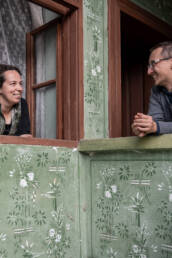
Ioana and Georgi
by Ioana Moldovan
On the first day of her master’s degree at the Central European University, at that time still in Budapest, Ioana was running late. She got lost in the hallways of the university. She entered class after the presentations had started and was desperately looking for a free place to sit down so as not to attract any further attention. She spotted one next to a guy she didn’t know and had never seen before. Asked hastily if the seat was taken, Georgi replied “with a calm that has become history”: It’s your seat. So begins the story to tell their grandchildren.
In 2014, Ioana and Georgi, a Bulgarian by birth, were two former journalists making the switch to history at that master’s degree.

I think we were the only ones or among the only ones from Eastern Europe, feeling a bit inadequate for coming from the world we came from, among many former Princeton and Harvard students.
Two years later, in 2016, they became husband and wife.
In the early years they traveled extensively. They changed three countries and six homes. Georgi had a PhD research fellowship and they lived in Berlin for a while, Budapest for a while, in Bucharest and in Joanna’s native Fagaras.
“It was okay because we both liked this thing, this challenge of travelling, getting to know and fitting in somewhere.”
They now have two children, a four-year-old girl and a two-year-old boy, and live in Harseni, a commune in Brasov county, after deciding at the start of the pandemic to rent a house and move to the countryside. “This move to the countryside, for example, you couldn’t do it in a family if there wasn’t common ground, if one was very urban, very willing to stay in the mall, in the club, to walk on boulevards and dependant on everything that a city and urban life means, and the other wouldn’t feel comfortable with that,” adds Ioana.
Within the couple, they speak in English, although Georgi has started to do very well in Romanian. So well that often, when he goes to the village shop or the market, the villagers don’t even realise he’s not Romanian. “I must say I like the words and I like how the language sounds,” says Georgi, “but the grammar is very difficult for me. The Bulgarian language is more simplified, we don’t have cases and these complicated grammar rules. The alphabet is different, but for me it’s easy because I know English. And we have many Slavic words in common, like potato, carrot, table, many words. I enjoy discovering these common words.”
With the children they speak in three languages: Ioana speaks with them only in Romanian, Georgi only in Bulgarian and together in English. For them, language has not been an impediment.
I didn’t feel that the language barrier is something between us.
She puts this on the fact that verbal communication is a small percentage of their communication and that they resonated on all important levels. “I asked myself that question at the beginning, I was wondering how it would be. Even a friend of mine said, wow, you won’t able to explain how much you love him in your own language. No, I simply never felt that barrier.”
At the time they got married, they didn’t realise what the cultural differences between them would mean. They hadn’t spent much time together before, Georgi hadn’t spent any time in Romania, nor had Ioana in Bulgaria, except, briefly, on holiday. “I was thinking, well, Bulgaria might be nearby, but it’s a different country, it has a different recent history, a different non-recent history, put simply it’s very different things, culturally, that shaped them,” says Ioana. She thinks their sense of humour helped them a lot. Sometimes joking, sometimes really wanting to discover more about each other, they would ask, preemptively: “in your culture…”
“We have a lot in common,” says Georgi, “both countries are very close. In terms of mentality, culture, we are not so far apart, Bulgaria and Romania.”
For Georgi, a religious person, the fundamental common ground is the Orthodox religion. “It is something very important, the most important.” He’s also glad that the two are neighbouring countries and he can easily visit his family.
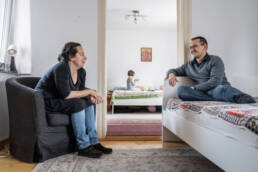
“But, of course, there are some cultural differences,” he continues.
He particularly refers to the culinary side, comparing Bulgarian food, which he perceives as simple, to the rich and tasty Transylvanian food. A special place in this culinary culture shock goes to meatballs sour soup. “My mother-in-law cooks meatball soup, and the meatballs are really big,” says Georgi. “In Bulgaria, we have the same dish, but they are extremely tiny. And here in Transylvania, I feel that every meal is like a feast, so nice, so rich.”
Ioana also mentions the Transylvanian chicken soup with noodles. “They don’t have soup, they only have sour soups,” she says. That reminds her of their wedding. They had a small wedding in Sambata, with just family and very close friends. “We wanted to have something traditional, so we made this soup, more so at the request of my friends from Bucharest, who came to Transylvania and were crazy about chicken soup. All the Bulgarians asked for lemon or vinegar. Of course whoever was cooking there, and all the Romanians, went crazy: profanation!“, Ioana recalls with a laugh.
One important thing that Ioana and Georgi have in common, and the thing that brought them together, is their passion for history.
“We are both interested in history. Recent history, the communist past,” says Georgi. “Both countries have a common past, communism, similar regimes. We study that together. When we met and also now, we continue to discuss common projects, common ideas and very often in the evening we talk about it. We talk about history.”
Now, they both work, among other places, at the Fagaras Research Institute, a local NGO. Even if officially, on some projects, they are not part of the same team, they work as a team at home. “We discuss project challenges, questions the other might have. For example, one of us may see something the other misses and vice versa,” adds Georgi.
Ioana is now working on a graphic novel on recent history, based on her family’s story and its involvement in the Resistance. She hopes to have it ready early next summer.
In the seven years they’ve been together, Ioana says, she hasn’t identified one key things that she and Georgi don’t resonate on. This includes their view on family, on relationship with the children, on life.
I think that, in all the essential aspects of life, from personal, relational, to professional life, we have been a great fit.
Next:
Maria and Cetin
