
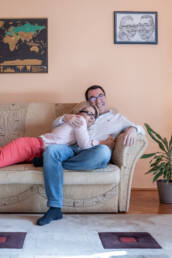
Maria and Cetin
by Ioana Moldovan
On the 13th of each month, Maria and Cetin say Happy anniversary to one another. They never miss it. It’s the day they met, on a Saturday in August 2005, after a married couple of mutual friends kept trying to set them up on a date. The first attempts had failed because Cetin kept changing plans last minute, saying he had to go to Techirghiol on weekends, to visit his parents.
When he would stay in town, he dedicated Saturdays to cleaning. That’s why, on his first date with Maria, without realising it, Cetin smelt strongly of Domestos. He recounts with much humour about that evening and the three moments in which Maria surprised him. First one: the married couple had brought Maria flowers and a present because her saint name day was coming up. An ethnic Tatar, Cetin didn’t keep much track of saints. Remembering his school days when he would yell from the back of the room that the flowers given to the teacher by one of his classmates were from the entire class, Cetin moved closer to the couple at the time they handed the present, trying to use body language to assert his contribution. Maria thwarted his plans, asking who the flowers were from so she’d know who to give a kiss in thanks. Not wanting to lie, he stepped back.
“Who could ask such a question that would put someone, namely me, in such an embarrassing situation?” was Cetin thinking. “I loved that!”
Moment number two: at the restaurant, Maria ordered for him as well, telling the waiter, when he asked Cetin about the salad, that they would share the one she ordered. “Again I was laughing inside: look, she answered in my place,” Cetin recalls. The third moment was on the way back home, when, after listening to his stories about having fun with friends in Constanta, Maria asked him: but how much do you earn and how much do you save?. In a very professorial tone, she continued that it’s not good to spend more than you earn.

I’ve never met anyone so blunt, asking you how much you save, at least not on a first date.
“I need somebody like her,” he thought, in the idea that she could temper his spending.
Feeling bad that he didn’t get her a present, the next day Cetin bought her a green blouse, the same color of the tank top Maria had worn the night before, the book “Why We Love Women,” a packet of biscuits, and asked her out on another date. Four years later, they got married.
Their parents didn’t know about their relationship. “I introduced her when we decided to get married,” says Cetin. In the small community of Muslim Tatars in which he grew up, Cetin, like all children, was always told how important it was to preserve religion and ethnicity; that first, it was important to marry a Muslim, and second, to marry a Tatar. “But why? That was one of the defining questions of my personality,” says Cetin.
Ever since I was a young child I couldn’t bear to make friends or acquaintances based on ethnicity.
In Cetin’s elementary school class, half were Tatars and Turks. “My best friends were a Romanian, a Macedonian, a Turk and a Tatar. It was nothing planned, it was just the way we fitted together,” he says.
Still, it wasn’t easy for him to tell his parents he was marrying a Romanian. “How do I present the case to Neni and Babai [his mother and father] without breaking their hearts?” He prepared intensely. Every evening he would read the Koran, page after page, passage after passage, until he found the one that said he was allowed to marry a Christian woman. He looked for examples of mixed couples getting along and of Tatars “who failed because they were not allowed to enter a mixed marriage”. He prepared answers about Maria and her family, from his parents’ perspective, to reassure them “that they are trustworthy people”.
For the weekend he went home with the news, he built a whole strategy. “If I tell them immediately after my arrival on Saturday morning, for two days they’ll be assailing me with questions and concerns,” says Cetin. “I decided to tell them on Sunday, at 1PM, because at 3PM I had to take the bus from Constanta to Bucharest, so I had to leave.” He also came to the conclusion he should tell them separately. He told his mother first, in the hope that she would support him in talking to his father. She started to cry. He tried to reassure her with all the arguments he had prepared beforehand.
“And we get along well. I couldn’t tell them… and I love her. We did not discuss such things within the family, it was not an argument I could convince with. That we get along, yes.”
Then he told his father. “Look, I’ve met a girl. – Ah, very good, bravo. – And I want to get married. – Oooh, even better, bravo. – And she’s Romanian. Pause. Then he starts crying too. He starts crying, my mother starts crying.” He left there “drained of energy, but relieved”.
Cetin and his mother used to talk on the phone every morning, and their conversations were always rich in content. For two weeks after he gave them the news, she felt cold and tearful, answering only yes and no. Then, one day, everything changed. Her energy came back, she spoke with excitement, she spoke with a smile. “I had a dream!“, Neni told him.
I’m calm now, ulum, everything will be fine. I dreamt of two beautiful white horses, story-tales-big, pulling the same chariot. And I realised it was you and Meryem [that’s what Neni calls Maria].
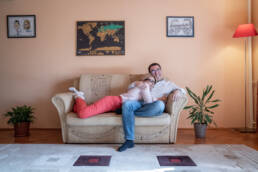
Cetin explains that his mother always had a special relationship with dreams, and that he would listen to her carefully whenever she dreamed of something. Before long, Maria became a favorite of his parents and family, at his own expense, as he likes to joke. “Neni would tear up when she would hear Maria speak various expressions in Tatar, or when I told her how Maria would wake up during Ramadan, to prepare my breakfast before dawn,” Cetin recalls.
They got married in Islam.
“We found an imam who taught us and guided us,” says Maria, “an extraordinary man who was of great support to me and explained everything.
I didn’t have to convert, the imam said that I can switch to his religion if I feel like it and want to, but that it’s not mandatory for getting married.” Although Maria’s family, with whom she has always talked very openly, didn’t have a problem with their relationship, Maria says the religious ceremony was the moment when they all truly eased their hearts. When they heard the imam, speaking openly and freely, explaining that the fact that she was Orthodox and he was Muslim should not be a barrier.
Maria remembers with pleasure the first time she visited for bayram. “I saw how nice it was to have all the family get together; the young ones would come to visit the older ones, all the siblings would come to their parents, with their wives, with the grandchildren, there was such a big table with everyone.” Cetin comes from a large family, with three brothers and two sisters, while Maria has only one brother. They also remember laughing when Maria, not knowing the custom, would question Cetin’s father. And with Tatars, one does not argue with the head of the family. “Until I got into the rhythm, to get to know them, it was quite hard, because no one had “trained” me,” says Maria, “that’s why I kept asking why? and my father-in-law got annoyed. Because that’s how it is with the Tatars, that’s how it is with us! I used to tell him that if nobody explains things to me, I can’t understand.”
What was important to us was to continue with each our traditions, especially since they were on different dates, we didn’t have to choose which one to celebrate.
Maria continues. But also to embrace each other’s. Out of respect, Maria chose to stop eating pork. “Even my parents embraced it for us. For example, at Christmas, when all kinds of pork products are specific, they prepare beef and mutton for us. They’ve actually started to prefer it too. My mother even has different pots so they don’t get defiled. She respects that about us and, most of all, she respects him. They eat their food, we eat ours, but they are always careful about this stuff.” Cetin really appreciates that about them.
“We have a thing: it’s important that both of us, through what we do, have a good time and we don’t really care what anybody else says,” Cetin adds.
“There’s no point in us changing our lives based on what people say.” He refers to some of the nasty comments he still gets on some Tatar Facebook groups for being married to a Romanian woman.
“Out in society, when people find out I’m married to a Muslim, they say oh dear, poor you, just wait and see,” says Maria. “Even the maintenance lady, when we moved into the apartment building, said Ali? Yes, my husband is Tatar. Oh dear, poor you. Well, you’ll see later.“
What really matters is that we listen to each other, we talk a lot and tell each other everything.
“We have tense situations too, like any family, but we discuss them together and find a solution to anything,” adds Maria. “We have a motto: we never go to bed angry and none of us leaves home angry. We always have to leave with a smile and know that everything is okay.”
They’ve also discovered shared passions: they like to run, participate in marathon competitions, and love to travel, especially just the two of them.
“We’re passionate about visiting, walking. We even have a goal: to reach 6 continents, 60 countries and 600 cities in 20 years. At the moment we’re at 33 countries and 120 cities,” says Maria.
“And we have set our mind to, in two years time, inshallah, so be it, to do a world tour in 90 days. We’ll take three sabbatical months right around the time we’re the same age, 45.” Maria is nine months older than Cetin, and for three months in a year, between January and April, they are the same age. Until then, they don’t let any birthday or anniversary pass them by. “And every year, we look back at our memories posted on Facebook or at pictures taken – we take a lot of photos as we are happy to create memories together – not to forget that these are our moments and they are beautiful and we enjoy them,” says Maria.
Next:
Gentilia and Catalin
