

Cristina and Mohamad
by Ioana Moldovan
By the time Mohamad first messaged her on an online dating app in 2016, Cristina was already fed up with the negative experience of previous interactions with foreigners on this medium. And of many’s perception of Romanian women. So at first, she didn’t give him a chance. A few months later, he wrote to her again. He caught her in a “better mood,” Cristina jokes, and she replied. A few days later, they went on their first date.
Mohamad came to Romania in 2007, to go to university. Around the same time Cristina moved from Pitesti to Bucharest for the same reason. Mohamad’s father had been in Romania since 1992, but his mother didn’t settle in very well here and, soon after, returned home to Syria.
They saw each other a few times and the relationship evolved from there. They also went on a holiday trip together. Cristina says it brought them closer. For a month and a half, however, Cristina didn’t realise that Mohamad understood Romanian well. She somehow assumed, based on the fact that he preferred to speak English, that he was not good at it.
“The whole time I was talking to people on the phone about him, with him present, in Romanian, thinking he didn’t understand a thing,” Cristina laughs.
“Can you imagine how much nonsense I was telling my mother or who knows who on the phone about him?” She consoles herself with the fact that she couldn’t have said anything bad, because Mohamad had really made a good impression on her. Her surprise came in a furniture shop, when he started having a whole conversation in Romanian with the shop assistant.
“I can manage,” Mohamad told her modestly.
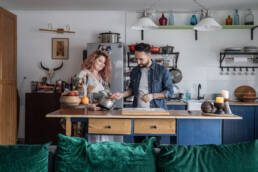
It was around the time Cristina was renovating an apartment she had recently bought, and Mohamad was helping her with that. He’s passionate about woodworking. Many of the pieces of furniture that decorate the house they live in now are made or refurbished by him. “I had no savings for decorating, from paycheque to paycheque we were doing something more,” says Cristina. “Little by little, he helped me put it together. I did not have a driver’s license and he would drive me everywhere to look for stuff. I don’t know how many men have the patience to go, weekend after weekend, to pick up one box of tiles or one table,” Cristina says appreciatively of Nadim, the name – his surname actually – he usually goes by among friends and close ones. Nadim explains why. “I’m from Damascus and there they have this thing with Mohamad, add it by name, and by surname. When the teacher calls out Mohamad, half the class says yes. Nadim is easier, everyone calls me that,” he says. Except his mother.
Working together at Cristina’s apartment led her to discover a passion for interior design. She was inclined to design, but more so for clothing.

She found a passion, I had a passion for wood and somehow it all came together.
The house they live in now is also decorated by them. “Now, every couple of days, she comes up with a new idea, let’s change that,” he says with a laugh. He tempers it by telling her that it’s easier said than done.
They joke that they have another passion in common: “He likes to cook, I like to eat,” Cristina laughs. Nadim is really passionate about cooking, he even has a YouTube channel where he shows or invents all sorts of simple recipes that can be prepared easily and quickly. “I don’t cook much because it’s his passion, I’m responsible for breakfast,” says Cristina. “And you can’t say he’s dying for Romanian food. He eats it, but if I make, for example, slow roasted cabbage with something, he eats one portion and then I have to finish the rest of the pot.” Instead, he likes the sour soups, of which his favourite is chicken à la grec.
In the summer of 2017, Nadim took Cristina to Turkey to meet the rest of his family. His mother was forced to leave Syria because of the war and now lives, as a refugee, in Turkey. It’s an unusual thing for Muslims to take their girlfriend home to their parents. But Nadim’s mother, though a religious person who prays and fasts in Ramadan, was open-minded.
My mother’s theory is that you shouldn’t force your child to choose someone.
“It’s his life, when he’s happy at home, he’s happy. If he’s not happy, he’ll come to me saying that I chose that girl and look where he ended up because of me,” are the mother’s words. She did, however, tell acquaintances that the two were married before God. Something that Cristina and Nadim did the following year.
“That’s when I found out I was getting married,” Cristina says with a laugh. “I heard my name in a conversation Nadim had with his mother and asked What about me?” “Ah, we were talking about our wedding,” he replied.
They were wed in Turkey in 2018, because Nadim’s mother couldn’t leave the country. It was a small ceremony, just family: Cristina’s mother, Nadim’s mother, sister and nephew. “The traditional wedding is more lavish. Ours, because we were basically tourists there and his family were refugees, was practically it in the living room,” says Cristina.
Cristina remembers with amusement something her mother told her when she was younger: “anything but Muslim”. Then meeting Nadim, seeing that “he’s a good boy, a dutiful boy, he does everything”, changed her perception.
“She’s super in love with him and always turns to us, and especially to him,” says Cristina.
About Nadim, Cristina thinks he is very European-like, which upsets his father a bit. “You can’t say he’s… more Romanian than Arab, but he’s more European-like. When we go on a holiday somewhere, I don’t know, we’ve been to France, you can notice about him that he feels more comfortable than he would in an Arab country. That’s how I sense him.” “Somehow that was the idea,” says Nadim.
I didn’t leave Syria because I couldn’t stay, it wasn’t at war yet, I left because I didn’t want to stay.
There is this culture there where it matters who your friend is or who your father is, and I don’t like that kind of people.”
He thought that in Romania, being Europe, people are more open-minded. But he was in for a surprise here too. He recounts how after breaking up with an ex-girlfriend, he was shocked to find out that one of the main reasons was that her family didn’t agree with the cultural and religious differences between them.
“Since he met me, and started speaking Romanian more, meeting with my mother, and meeting people from the countryside, he started to see that Romania was somehow totally different from the Romania he knew from university.”
When you don’t understand what they’re saying, people can seem nicer.
Neither she nor Nadim are religious people. “Neither of us are into religion, traditions, we celebrate Christmas because everyone does it,” says Nadim. “Cristina, for example, doesn’t even know when Ramadan is coming, when we have holidays there, because I don’t follow it either. I just watch TV, look, it’s that event, I have to call my mother.” This makes a lot of potential dissension simply disappear. Not all, though. ”Nadim doesn’t believe in saint (name) days,” Cristina says with a faint hint of disappointment. “So I don’t even get a congratulations, anything,” she alludes. “No, I don’t get the idea,” he replies briefly.
Now, Cristina and Nadim are expecting a baby. A boy. “This is where I think the religion thing steps in,” Cristina says. She tells of an argument they had early in their relationship, in which Nadim said, “Our baby will automatically be Muslim.” Because Muslims take after their father’s religion.
“I never wanted to baptise the child,” she says, “I said that when he understands what the religion and customs mean, he can choose for himself what he wants to be.”
There were some discussions about the child’s name as well. “He doesn’t like Romanian names,” says Cristina, “and I find Oriental names, boys’ names, very harsh and don’t sound melodic.” “We wanted something more generic,” Nadim adds, “not to be very typical, so you can tell by the name that he’s Muslim or from Romania.”
Mohamad has his own experience with how problematic a Muslim name can be. Especially when travelling.
At the airport, I’m always the random check.
says a frustrated Nadim. “And not just at baggage, for drugs, for bombs, for all the crap.” “When they see Mohamad in the passport, they look 15 times over,” adds Cristina.
They looked for an Oriental name, but less typical. They were left with two options: Ayan, her choice, and Rayan, his. Eventually they settled on Liam. “I still sometimes dream at night that the baby’s name is Ayan and not Liam,” says Cristina.
Cristina has always believed that she doesn’t need a father for her baby if she doesn’t feel 100% comfortable with that man. It’s something that stems from her own relationship with her parents.
“When we decided to have a baby, we’ve done so because we really have the same mindset about parenting, about what the minimum of common sense means, because morally, we’re very much on the same page,” she says.
She adds that she doesn’t focus on money or fame, but rather on being an okay person, on one’s character and soul. And that she found all of the latter in Nadim.
“We’re the kind of couple that, it might sound boring to others, but we do everything together. In five years, I think it’s been less than a week that we haven’t slept in the same house. And we make decisions together, we’re very close,” says Cristina.
All they want now is to live peacefully.
We’ve reached the point where we just want peace, quiet, to raise our child in a beautiful environment.
Next:
Özen and Laurentiu
